


















Smell in VR is still severely lacking, and at UnitedXR, I met a company working to fix it.
Scentient is one of those startups that sees an opportunity, a blank space to fill, and they’re actually doing it. Smelling various scents is undeniably crucial in our lives, even if we don’t think about it every day. Scent is closely tied to our memories, our recognition of danger (and safety as its contrast), and the way we emotionally experience the world around us. But we don’t have that in VR, do we?
Virtual Reality currently unlocks only a few senses for us: vision, hearing, and, in some ways, touch. We can’t directly smell or taste anything in VR, and it’s not really something people miss when deciding what game to play next on their Quest.
While tasting a burger in Job Simulator or smelling burnt oil in a VR kitchen would definitely push immersion to the next level, it isn’t crucial – and it’s certainly not as simple as putting displays, lenses, and a speaker in front of our face. Those technologies were refined long before VR existed, and now they’re relatively easy to integrate compared to a device that can simulate smell or taste.
The Solution to the Problem
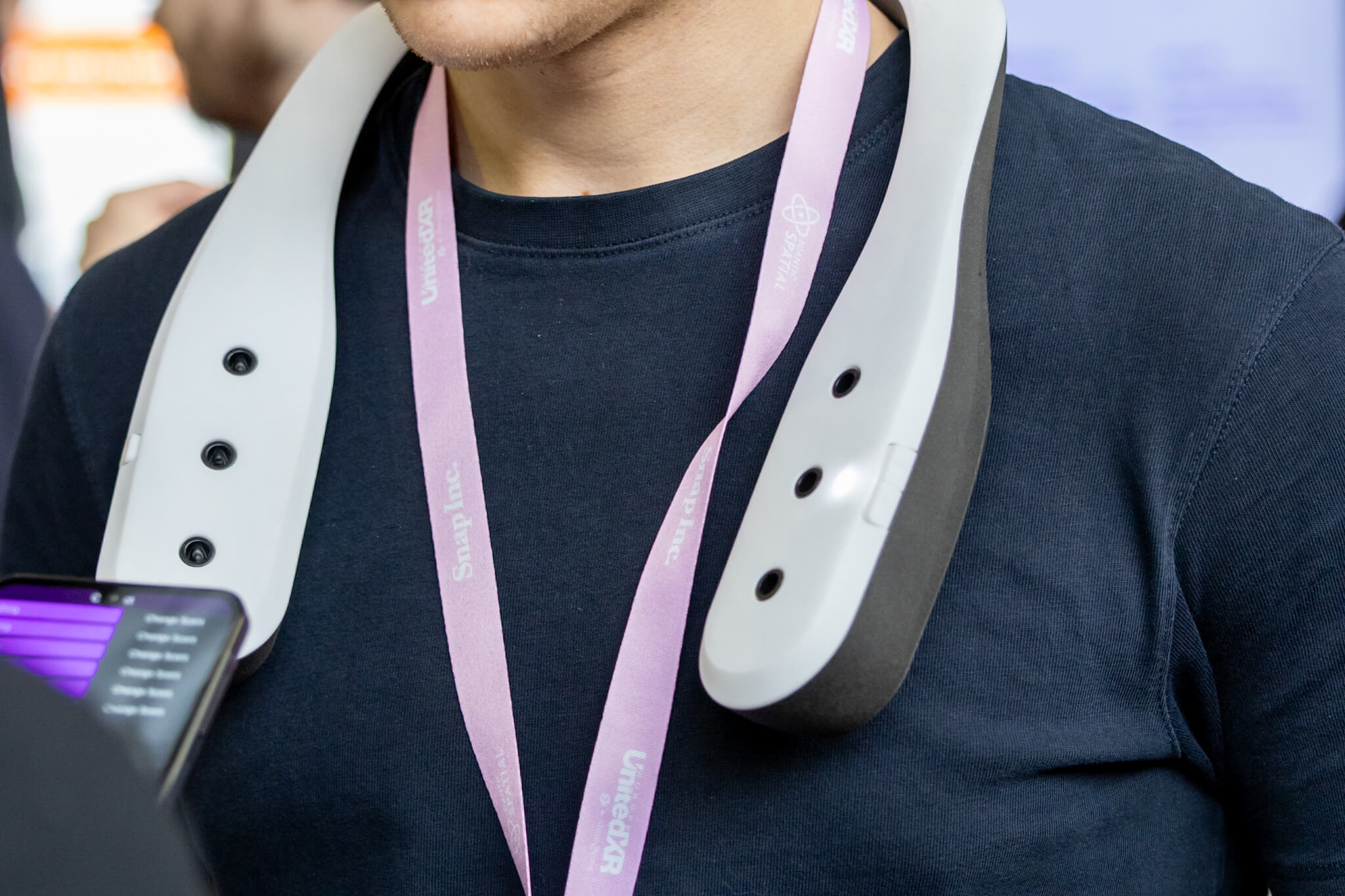
One company – the UK startup Scentient – is trying to change that. At UnitedXR 2025 in Brussels, I met with Anastasia Georgievska, a co-founder of Scentient. She told me a lot about the company, gave me a demo of their device called Escents, and was kind enough to give me an interview that you can find below my impressions.
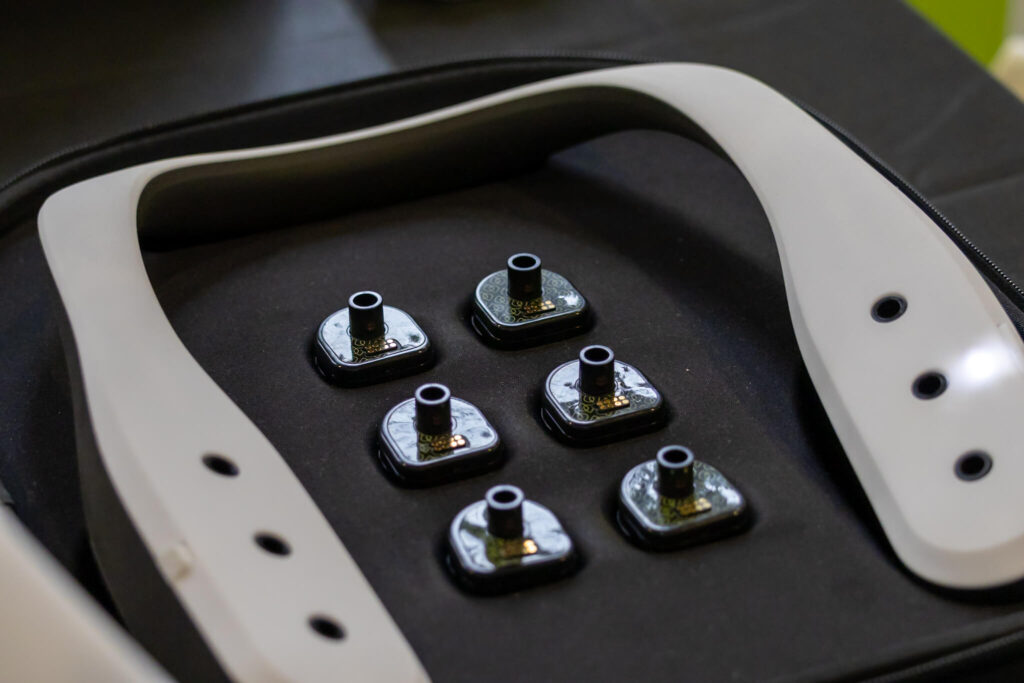
Escents is a large “neckband” that sits around your neck. It has six scent pods that gently release smells toward your nose so you can sense them naturally. Its open design is also a big advantage – I didn’t need to wear anything in front of my nose, I could breathe normally, there was no added weight to the headset, and the overall experience was very comfortable.
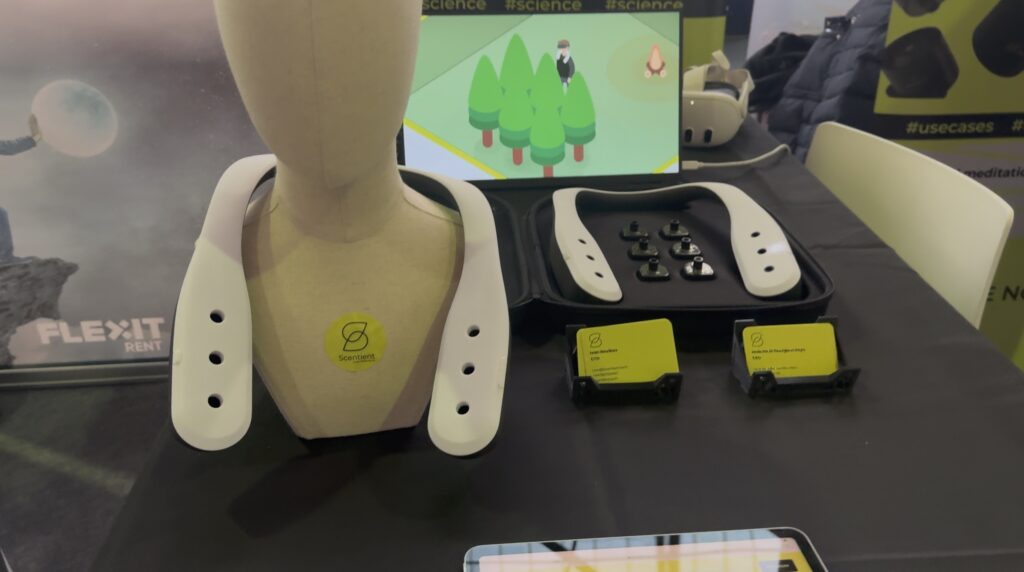
I could smell petrol, chocolate, and flowers. Unfortunately, I couldn’t test it inside a headset, as the demo wasn’t available on the first day of the event, and I didn’t have enough time to catch them for a longer demo on the next day. Keep that in mind – I didn’t test Escents working in VR. Scentient says it works in headsets, and I don’t doubt that, especially since I’ve seen similar solutions work without any issues.
You can imagine several use cases for this. One example is training. You could smell burning fire while practicing how to evacuate a building, or during firefighter training. The added immersion of scent would significantly improve retention, helping trainees remember the experience much better.
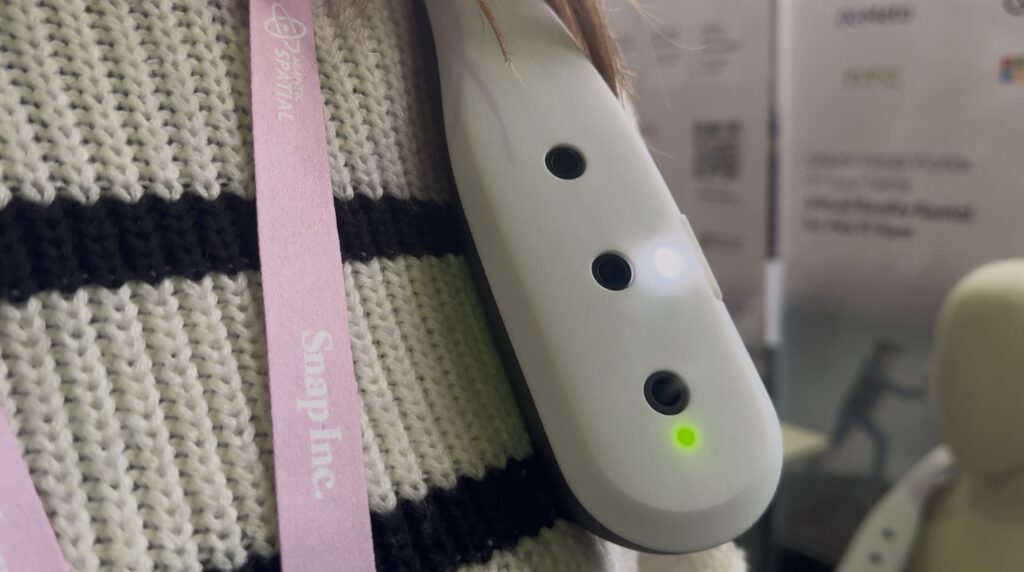
With Escents, Scentient is tackling the broader problem of missing scent in digital media as a whole. It’s not only meant for VR/AR devices but can also work with smartphones, for example.
They’re also launching this week – and she told me that pre-orders are already open!
With that in mind, I recommend reading the interview below, as it answers a lot of questions about safety, developer integration, more about Scentient, and Escents itself:
The interview with Anastasia Georgievska, a co-founder of Scentient
Cezary Sobociński, XRDailyNews: Hi! Can you describe what Scentient is, and what your mission is?
Anastasia Georgievska, a co-founder of Scentient: Hi! So, we are adding smell to immersive technologies. This is our device – It’s called the Essence, and it goes around the neck. It connects to a VR headset, AR glasses, or a phone. And essentially, it can be triggered by anything that has Bluetooth.
We add smell to all of the experiences, so we have a pod system. So, all of the smells are very specific, and they can be magnetically plugged into the device. And these are smart pods, so the devices can detect what kind of smell is put in.
XRDailyNews: Okay, so how does your device connect to the VR headset or smartphone, and how does it know which smell to release and when?
Anastasia Georgievska: So, we have a Unity API. When you’re building the experience, you can put trigger points within your experience, indicating when the scent should be released. And you have full control of the intensity of the smell and the timing for how long to release it.
And you can make it interactive, so you pick up the object and smell it. Or if you’re coming close to, for example, a fire, you’ll be able to smell the fire. Today, we’ve been showing a demo of a table with a few different objects on it. You could smell figs, you could smell hot chocolate, flowers, or even petrol for training purposes. And then you could also come close to a bonfire and stand under a pine tree and smell it as well.
XRDailyNews: What impact have you observed it having on your clients, and what are the main use cases you see?
Anastasia Georgievska: Smell is incredibly impactful on the way that we perceive the world. So, we believe that it’s really important to add it to the virtual world and virtual experiences as well. One of the strongest use cases is in training. Training scenarios for first responders, especially.
For example, a gas leak is silent and invisible. So, with just audiovisual inputs, it is impossible to recreate full training. So with smell, you can actually train that as well. You can also use the smells for training to desensitize the trainees to difficult situations that they encounter on the job.
And also, the smell is closely associated with memory. You probably know some smells that bring you back instantly to the past or to a specific memory? So just like that, it’s really important in training to aid protocol retrieval when you are in an actual scenario where you have to focus through all of the sensory pressure.
And also, we work in wellness experiences. So, it’s really amazing how impactful a sense of smell is for deep meditation and things like that for recovery. And we’ve worked with filmmakers and added smells to films, so we work across all of the different industries.
XRDailyNews: But I’m wondering – is it also meant for consumer entertainment? Can I buy it and use it myself as a consumer? How does that work?
Anastasia Georgievska: Yes, you can buy it, but our main focus is business-to-business work. We usually collaborate with companies on a wide range of projects. We also create custom scents — not only can you choose from our existing scent library, but we can design entirely new fragrances specifically for your experience.
XRDailyNews: Okay, so I see there are slots where I can insert the scent capsules. How often do I need to refill them?
Anastasia Georgievska: All six pods, when used together, last for about 50 hours of operation, which usually means a couple of weeks of use. We also offer refill packages – we sell the scents in kits of six pods. Since we care a lot about sustainability, we provide a refill program with a price reduction. Customers can send their used pods back to us, and we refill them so nothing goes to waste. The pods are very durable, so they can be reused many times.
XRDailyNews: Is it generally safe to use? Are there any limitations, or could it be dangerous in any way? What’s your view on that?
Anastasia Georgievska: That’s a very good question. Safety is extremely important to us. We are IFRA-certified – that’s the International Fragrance Association – and we work with professional partners who design scents alongside us, all of whom are properly registered and certified.
We ensure that every scent and ingredient we use is safe. Depending on the formulation, we use either natural ingredients or safe synthetic ones to make sure everything is as clean and harmless as possible for the user. We also work with very low concentrations, and the device has plenty of free space around it, ensuring good airflow. So yes, it is very safe to use.